Spring Storytelling Salon — April 2026
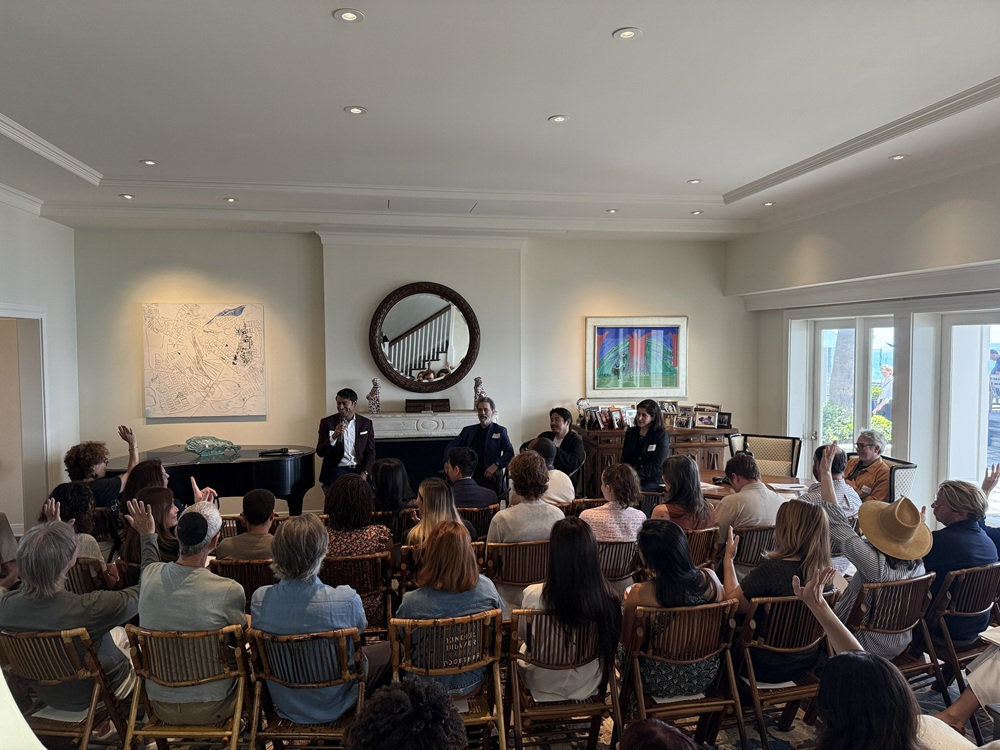
As America’s 250th anniversary approaches, we convened sixty storytelling creatives, executives, and educators to uncover how our craft can bridge the gap between a polarized country and an audience craving connection. Guests represented a wide spectrum of the industry, from viral digital creators to writers and directors on Star Trek and Cocomelon. Affiliations ranged from A24 to HBO, from The Wonder Project to Lucasfilm and Paramount, from NYU to CalState and Ghetto Film School.
This salon-style brunch by the Malibu Coast featured opening reflections from Bao Nguyen (BTS: The Return, The Stringer, The Greatest Night in Pop) and Dr. David Caplan, PhD (The Conners, George Lopez). The conversation also included insights provided by Democracy 2076’s Melody Mohebi, PhD.
Guests spent time getting to know each other, prompted by questions provided by Living Room Conversations. They then transitioned into the salon where Steven Olikara (CEO, Bridge Entertainment Labs) spoke about the relationship between storytelling and democracy. An entire storytelling industry was built on our country’s value of freedom of expression, and now it’s up to us as storytellers to keep our vision of pluralism and viewpoint diversity alive as we reimagine America’s democracy for the next 250 years.
Steven introduced our new “Storytelling Principles for Creating New American Stories of Us,” which provide insights for storytellers to help them bridge societal divides and reknit the social fabric. And our partner Democracy 2076 discussed highlights from their “The Power of Story to Grow Democracy” report, which examines what kinds of stories have the power to foster a more resilient democracy. View their Questions for Executives and Creatives here and learn more below.
Here’s some of what attendees said about the salon:
“Appreciate the mix of optimism and skepticism. Important reminders we are coming from varied perspectives with different goals but ultimately want the same outcome.”
“Hollywood tends to be homogeneous in politics, beliefs, and worldviews. (BEL has) the opportunity to convince studios and showrunners to seek out differently-thinking people into their rooms.”
“Great program. The science behind empathy and (its link to) entertainment.”
Here are a few of our favorite moments:
The Power of Curiosity
BEL Advisor David Caplan explained that the 4 Cs (Curiosity, Contact, Complexity, and (Good) Conflict) aren’t about telling storytellers to “eat their vegetables;” instead, it’s just going back to the foundations of what constitutes a good story. Steelmanning characters with views we might oppose, rather than strawmanning them. Showing characters who are not just complex, but (as Emmy-winning producer Sarah Yourgrau (founder, Common Ground Studios; co-host with Mike Rowe, People You Should Know) points out) flawed — because the truth is, having messy lived experiences is what enables your characters to connect and relate to diverse audiences. When storytellers can tap into their innate empathy, curiosity, and flaws, they can tell stories that resonate with a broader swath of the American public.
David described how one episode of The Conners leaned into Curiosity. During the pandemic, this episode featured characters on both sides of the masking debate. Each character was given an opportunity to share their “emotional truth,” and, because the characters’ views were more complex than what we see on cable news, they actually found some common ground.
A guest who worked on a Star Trek TV show said it best when talking about Captain Kirk: “The true leader has empathy and understanding that you have to understand both sides. And never forgetting that everybody is human is part of being a good leader.”
Complexity Makes Audiences Lean In
A guest who worked on the HBO reality TV show Neighbors told a similar story. He said that the most entertaining moment of each Neighbors episode is often when the audience feels surprised by a character: “I thought this character was like this, but he’s actually like that.” When audiences are surprised by complex characters, they lean in.
A documentarian discussed the importance of complexity in telling documentary stories. When we assume a lack of malice on the part of our subjects (or their opponents), we can craft more vulnerable and nuanced stories. Most true stories also aren’t cut-and-dry, and leaning into the “fog of war” can help audiences to grasp the bigger picture instead of coming away with only one perspective.
The Unifying Power of Storytelling
David Caplan pointed out that as human beings, we’re wired for storytelling. When we say “wired”, we mean literally: our capacity to remember and to tell stories is why our brains are so large, relative to other animals’. Stories are the only thing capable of uniting a country as big as ours.
A writer/director who grew up in a trailer park in Georgia commented on the need for more regional representation in the industry. “Not a lot of people sound like me (in Hollywood),” he said, and reflected upon how misrepresented “his” people have been in the films and TV shows that he’s watched. He’s committed to flipping the script on this by leaning into his roots, even if his accent at times has made his journey in the industry more difficult.
Reaching Audiences With Different Values
Melody Mohebi presented insights on the importance of reaching audiences with different values and made the case for values quadrants over the traditional age and gender four quadrants the industry often refers to.
Drawing on years of research and opt-in audience panel data from Harmony Labs (which gives them a window into the media behavior of 300,000+ people in the U.S.), Melody argued that audiences fall into four distinct values quadrants:
- “People Power” (insiders who strive to create a new and better system from within)
- “If You Say So” (outsiders who strive to change an existing system into something new and better from the outside)
- “Tough Cookies” (insiders who try to protect and preserve what works in an existing system)
- “Don’t Tread On Me” (outsiders who try to protect and preserve what works in an existing system)

From Democracy2076’s report, “The Power of Story to Grow Democracy.”
Each of these values quadrants can be represented by their own type of hero:
- “Insider Transformers” (who push systems forward from within)
- “Outsider Transformers” (who evolve systems to include previously marginalized people or ideas)
- “Insider Restorers” (who confront corruption from within)
- “Outsider Restorers” (who hold the system accountable)

From Democracy2076’s report, “The Power of Story to Grow Democracy.”
By incorporating heroes from multiple quadrants, stories can reach a much larger audience.
How Can We Beat the Algorithm?
How can we tell complex, nuanced stories when the algorithms currently prioritize simplistic “us versus them” narratives and ragebait?
The answer is to commit ourselves to telling good stories that resonate with people. It may take time, but eventually audiences will find and seek out these stories, and share them. The data supports this.
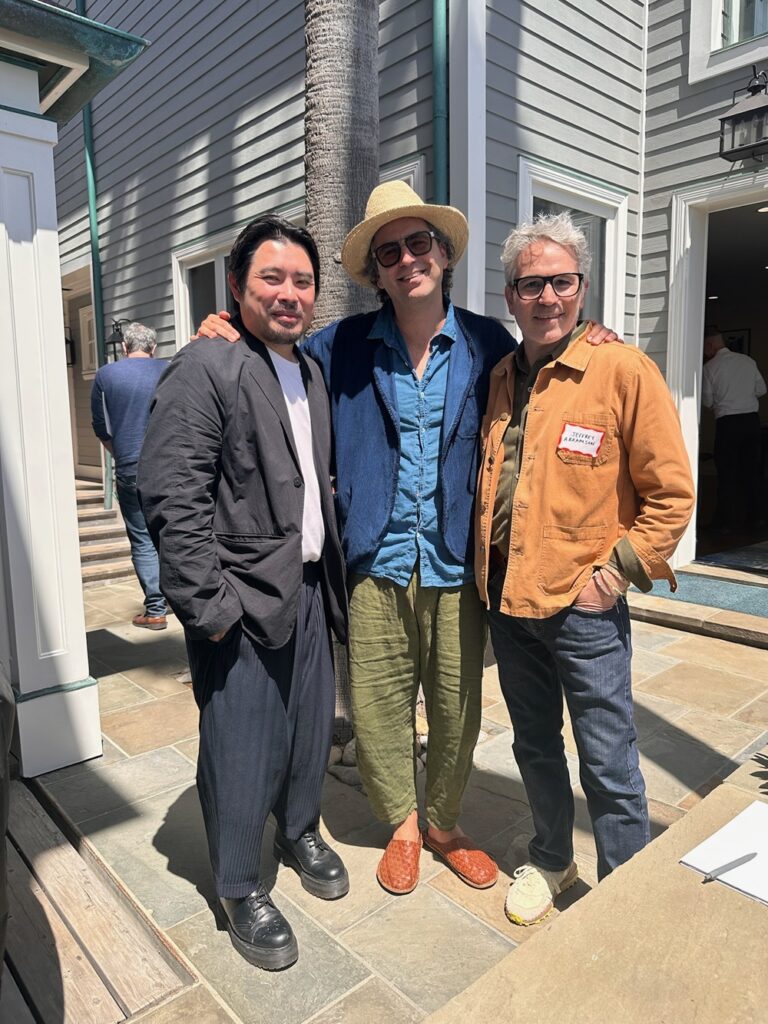
As BEL Chief Program Officer Jeffrey Abramson put it: if we build a cultural zeitgeist of storytellers telling stories that bridge, we can overpower the algorithms.
As David Caplan noted: the American story is constantly being rewritten. What resonated with our parents’ generation isn’t resonating with Generation Z. As storytellers, we have the opportunity and responsibility of deciding what the next American story is.